

here all belong
adulting & failing upwards: on third spaces, history, the human experience and my visit to the museum of fine arts, Boston.

The line to enter was so long it wrapped around the sides of the building and the sidewalk.
My friends and I stood in this very line, like the maybe hundreds of Bostonians waiting in the stabbing cold to enjoy five dollar Thursdays at the MFA.
We felt some much needed relief as we scurried into the museum building, and into the warmth provided by the bustle of visitors and central heating. After purchasing our tickets, we began our journey.
The first room we went into felt like walking through history books. It was a collection of musical instruments from different cultures around the world, and different periods of time. There were probably enough instruments in there for an orchestra ensemble. As I walked around and looked, I imagined each instrument came alive— a man seated inside of the display cases, eyes closed, drifting away with the notes he’s playing on the lute. Or a rockstar on stage with screaming fans, playing with the very first model of the electric guitar in all its cyan glory. At any moment, it felt like each of those instruments could’ve taken the shape of the history carved into their bodies and written on their strings.


The next room we walked into was a collection of jewellery from everywhere you could think of— from Chanel to Egypt, from Tiffany & Co to Ancient China. Walking through this room, I felt I must shrink myself, lest I break something. All the pieces felt so fragile, like if I stood too close to the display cases, the pieces would fall and break and their beauty would be gone forever. I got pulled into each of their worlds— the worlds of each necklace and bracelet and brooch— and lost myself in the way the precious stones on each piece glistened gently under the lights. It’s like staring into the most beautiful thing: you shouldn’t have to ever look away.


After trying (and failing) to get a clear view of the traditional Lunar New Year dances (that were also happening at the museum, we decided to take a look at the Egyptology exhibits. Looking at the sarcophagi, I remarked that there were real people buried in them, and even though they had definitely disintegrated to brittle bones and a mushy mix of tissues, hair and mummified skin, it was still someone. And now they’re living out the rest of their eternal days inside a giant glass cube, sparking the curiosity of generations to come.

Making our way through the rest of the pieces in the Egypt exhibits, one of my friends remarked that the art in these exhibits shouldn’t be in this museum.
Because of how important and relevant all of that art is to the country’s culture and history, she stated that they should be up in Egyptian museums. She also brought up the point that as an African, and with all of that art coming from an African country, she understood that some of the art in the exhibits could’ve been stolen from sites in Egypt, and not necessarily sourced ethically.
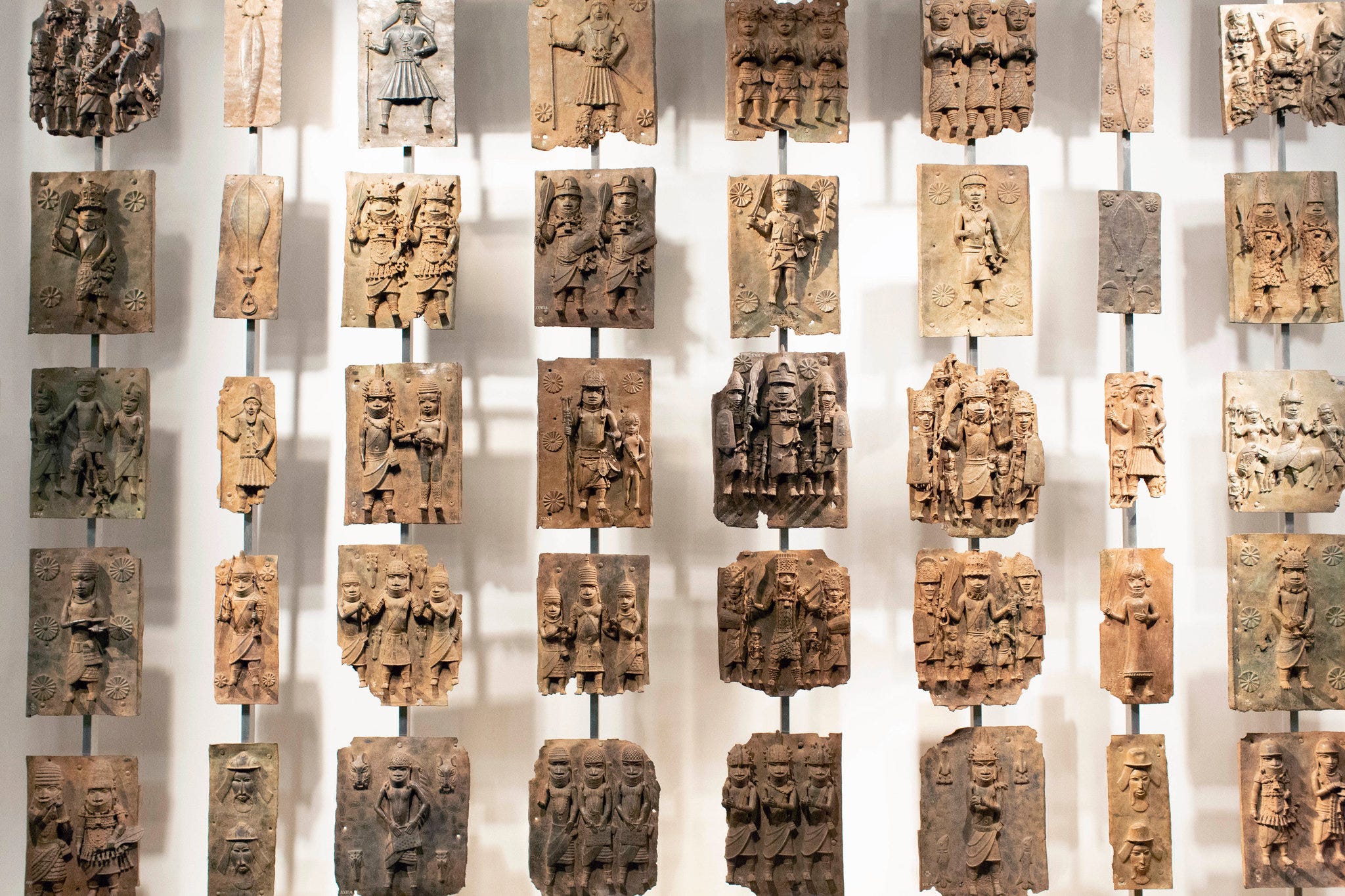
I knew she was mostly right. And if history were to be believed, she was really right. An example I remember learning about in my middle school art class was the story of the Benin Bronzes from my country, Nigeria. Thousands of ivory sculptures and brass plaques were looted from my country under the guise of a “punitive expedition”— a targeted military mission to punish a state for perceived wrongdoings— of which back in the 15th century could’ve meant anything.
You can check out the fragments of my country’s history today in the Smithsonian, the British Museum, or any Western globally renowned museum 🙂
One of the pieces in the museum that stuck the most with me was ironically enough, in one of the Egypt exhibits. It was a series of sculptures called “Reserve Heads” which is exactly as it sounds— a set of six clay sculpted heads, each made by the same unknown artist thousands of years ago.


What stood out to me was the fact that in this collection, no two heads looked alike. It would look that way on first observation, or from looking at them so simplistically. But if you stood close enough to look at each head, you would see the subtle but obvious variations– from the sizes of each head to the depth of each of their eye sockets, and even in the amount of pressure the sculptor’s fingers applied to mold each head and outline each crevice and wrinkle on each face.
It was the coolest reminder that each person is so different– molded by God and their parents and the pressures of life; everyone was shaped by these things differently, and therefore each person is entirely different from each person as a result. No matter how similar we may look or seem on first observance.
Another art piece I can’t seem to shake was made fairly recently, and is perhaps more political. We weaved through a room I assumed to be an exhibit for experimental art by artists of color, and I did a double take on one of the pieces. Not because it was so aesthetically beautiful, but because it was the opposite: it was stripped back, so raw and honest and bearing so much grief I needed to look at it. Really look at it.
Fred Hampton’s Door 2 by Dana Chandler made this art piece five years after the brutal assasination of the Black Panther Leader, Fred Hampton. The piece itself is a single door– painted in the Pan-African colors (red and green) to signify what Mr. Hampton stood and fought for, riddled with bullet holes and splattered red paint to signify blood.
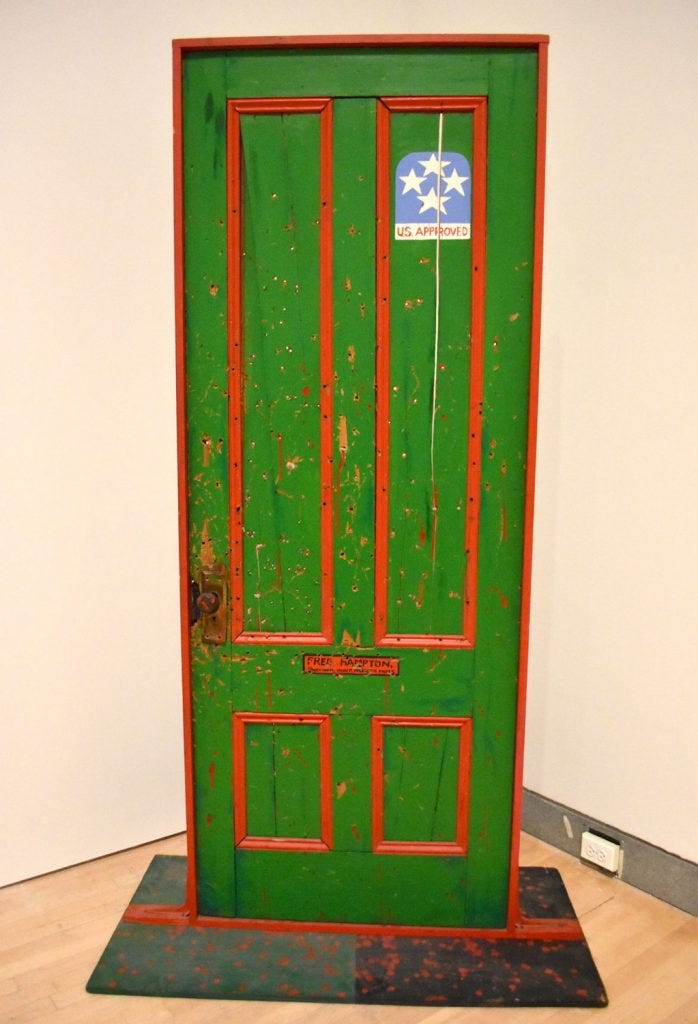
I think there’s something to be said about seeing this most not-subtle representation of violence in the mostly serene and teeth-white painted walls of the museum. This contrast makes the sadness and injustice of what happened to Fred Hampton even clearer, like slapping you across the face with it. And more importantly, this piece leaves a bitter taste in your mouth because you’re reminded that the divides we place against each other, to separate ourselves, to raise a certain group of us above the rest, have fatal consequences.
My favorite part of the museum, by far, was the room with the Baroque paintings.
Big. Emotional. Dramatic. Baroque paintings have always been my favorite. From the detailing in facial expressions, to the contrasts between light and shadow, and the theatrical scenes these paintings portray, I’ve always admired the amount of technicality, attention to detail, and zest for the dramatic that’s required to make these beautiful paintings. I would stare at the paintings for too long, and it would almost be like watching a movie: lovers painting together on a honeymoon, a woman fainting in the market square, or Moses sending down the seventh plague– take your pick and get the popcorn.


As I left the museum that night, the world around me felt akin to a history textbook written in real time. I imagined the jokes my friends and I made amongst each other, the lives we lived, our little delights, and the lives of each person I saw on my way back to campus being entered into this constantly updated archive of the complexity of our little dark age. I imagined our stories in museums just like this, and thought about the many stories and pain and joys and complexity that never makes it out of the lives of the people that experience them. Their lives would live beyond their death, yes, but in a tangible, physical sense, the lives those people lived are with them now, six feet under.
There’s something about being surrounded by so much art and history all at once that is a glorious assault on the senses, and I hope to go back for some more.
- from one oversharer to another, sewa :)
quiet argument that difference and memory are what make us human.